Read an artificial flower dimension diagram by following each measurement line to its endpoints. The longest line usually describes the whole stem shown; shorter lines may describe one open flower. Keep those measurements separate from the number of stems in the set and the height of a finished vase arrangement.
The SSKOI Classic Coral rose stem provides a useful example. Its source diagram labels a total length of 43 cm, an open-flower diameter of 9 cm and a flower height of 5.5 cm. These are the product source's nominal dimensions, rather than independent measurements taken for this guide.
Give each number a name before comparing sizes
Start with the object beside the measurement line. A line spanning the complete stem has a different purpose from a line crossing the open flower. On the Classic Coral source diagram, the three main labels can be read as follows.
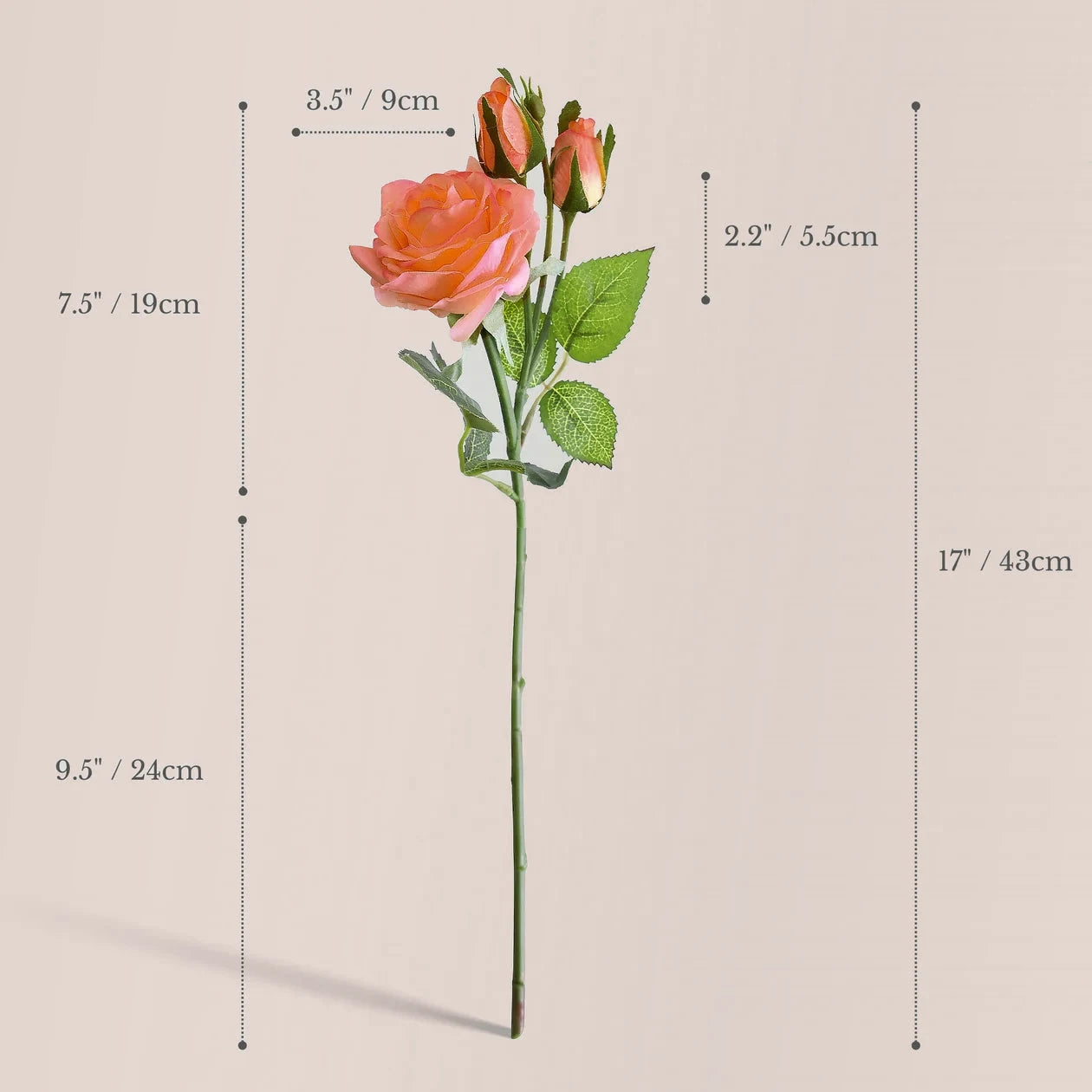
| Source label | What it describes | How to use it |
|---|---|---|
| 43 cm / 17 inches | Total stem length shown in the diagram | Start a height estimate before accounting for the vase and stem angle. |
| 9 cm / 3.5 inches | Diameter across the open flower | Picture the width of one open bloom. |
| 5.5 cm / 2.2 inches | Height of the open flower | Picture the height of the flower head in the shown view. |
The inch and centimeter labels express the same nominal sizes with rounding. Choose one unit for your notes so you can compare the stem, vase and available space consistently.
Follow the endpoints, including the tallest bud
Look at where a line starts and finishes. The Classic Coral diagram shows a branching upper section with one open bloom, two buds and leaves above a longer lower stem. The tallest visible point is a bud, so the full-length label should not be read as the distance to the center of the open rose.
The 9 cm label concerns the open flower, not the spread of every leaf and bud. Similarly, the 5.5 cm flower-height label does not describe how much of the arrangement will stand above a vase. When a diagram labels only a flower head, use that measurement for the head alone.
For a simple sense of scale, mark 9 cm on paper and hold it where you are considering placing the flowers. This gives you a width reference for one nominal bloom; the surrounding branches will need their own room.
Account for the part inside the vase
A stem's total length and its vertical height in an arrangement are different measurements. Some of the stem enters the vessel, and leaning the stem changes how far upward its tip reaches. The vase's outside height also matters when you judge the complete display from a tabletop.
Consider an illustrative calculation: if a nominal 43 cm stem stood vertically with 18 cm below the rim, approximately 25 cm would remain above the rim. This is an arithmetic example, not a measurement of a particular SSKOI arrangement. A sloping stem, raised inner base or different resting point would change the result.
Measure usable internal depth instead of assuming it equals the vessel's outside height. The faux-flower vase size guide explains how to check depth, opening and surrounding clearance. Use the finished arrangement to confirm the actual height.
Keep stem count separate from bloom and bud count
The Classic Coral six-stem set contains six main stems. Each stem has one open flower and two buds, giving six open flowers and twelve buds across the full set. The branching details belong to those stems; they are not additional loose stems.
A styled photograph may show a smaller subset, while overlapping flowers can make a complete group difficult to count. Check the stated set contents and the separate full-set photograph. Six stems with nominal 9 cm blooms do not automatically make a 54 cm-wide arrangement: the flowers can overlap, face different directions and sit at different angles.
This is the flowers-only set. A vase, tray, furniture or other styling props in a scene are not included.
Make a short measurement note before you decide
- Record the exact product. Note the flower family, color and set size so you use the matching diagram.
- Name the labeled dimensions. Write total stem length, open-flower diameter and flower height on separate lines.
- Measure your vessel. Record usable internal depth, outside height and the inner opening.
- Check the actual location. Measure the space above and beside the vase, allowing room for buds and leaves as well as the open flowers.
- Confirm the placed silhouette. With the stems in position, measure from the tabletop to the highest point and across the widest visible spread.
Use the diagram to plan, then let the real arrangement resolve the remaining questions. For a broader check of set contents and product photographs, read the SSKOI faux-flower buying guide.